

Contextual AI vs Generative AI: Why MSPs & SaaS Vendors Need Contextual AI Under Their OWN Brand
- Rob Mumby
- Dec 3, 2025
- 5 min read

The AI revolution isn't what most people think it is. While everyone's obsessing over ChatGPT's latest party tricks, smart MSPs and SaaS vendors are quietly building something far more valuable: contextual AI that actually understands their customers, speaks their language, and operates under their own brand.
Here's the uncomfortable truth: Generic generative AI is becoming a commodity. Every competitor has access to the same tools, the same models, and the same predictable outputs. The real competitive advantage lies in contextual AI: systems that don't just generate content, but understand the specific circumstances, behaviors, and needs of your customers in real-time.
Understanding the Fundamental Divide: Contextual AI vs Generative AI
Generative AI: The Content Creation Powerhouse
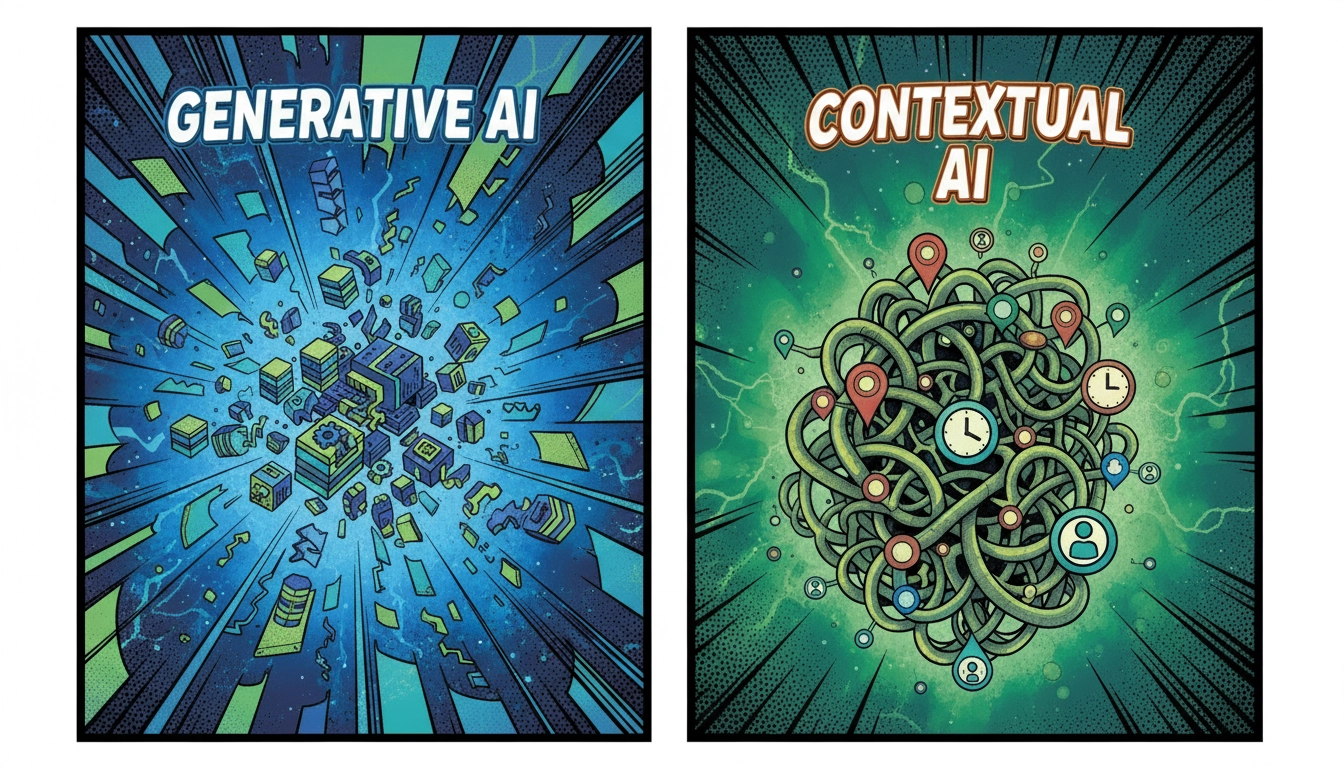
Generative AI excels at rapid content production: feed it a prompt and receive serviceable output within seconds. These systems leverage massive datasets and transformer architectures to generate text, images, code, and creative outputs through pattern recognition and statistical relationships. The technology is impressive, fast, and increasingly accessible.
However, generative AI operates with a critical limitation: it relies on statistical patterns rather than actual understanding. It cannot grasp nuance, context, or situational complexity the way humans do, often confusing coincidence with causation and producing responses that miss the mark entirely.
Contextual AI: The Situational Intelligence Engine
Contextual AI operates on entirely different principles. Instead of generating content in isolation, it moves beyond generic responses by considering the complete circumstances surrounding each interaction. This technology interprets information like humans do, factoring in ambiguity, subtle cues, and real-world signals including location, time, user behavior, and environmental data.
The key differentiator? Contextual AI learns continuously from live interactions, updating its understanding based on past conversations, user preferences, and situational awareness. While generative AI works at the speed of pattern-matching, contextual AI delivers situational intelligence.
The Strategic Imperative for MSPs and SaaS Vendors
Brand Voice Consistency at Scale
When MSPs and SaaS vendors rely on generic generative AI, they surrender control over their most valuable asset: their brand voice. Custom contextual AI models maintain consistent brand communication across all channels, generating responses that align with specific tone, style, and messaging strategies.
More critically, contextual AI speaks the language of niche markets, embedding industry-specific terminology and context to ensure messages resonate with targeted audiences. For MSPs managing diverse client environments or SaaS vendors serving vertical-specific customers, this capability becomes a strategic moat that competitors cannot easily replicate.
Competitive Differentiation Through Intelligence
In oversaturated markets where every competitor accesses identical generative AI tools, contextual AI emerges as the decisive differentiator. Organizations investing in contextual data infrastructure: understanding customer behaviors, preferences, and situational needs: build defensible competitive advantages.
The lesson is straightforward: generative AI requires more than prompt engineering; it demands context. Companies gathering contextual data and making it accessible to operational teams harness AI not as a generic content generator, but as an expert communicator understanding each customer interaction.
Asset Building vs Tool Rental
Custom contextual AI doesn't just perform better: it becomes a long-term strategic asset. MSPs and SaaS vendors train these systems once and reuse them across multiple teams, products, and customer journeys, delivering:
Consistent brand tone across all AI interactions
Faster resolution times in support operations
Higher accuracy on domain-specific tasks
Direct alignment with business KPIs including churn reduction and lead quality
Reduced operational costs per customer interaction
The Next Wave: White-Label AI Platforms by Default
The White-Label Revolution is Here
The next wave of engagement platforms will be white-label by default: because every provider needs its own branded experience. This shift represents more than technological evolution; it's a fundamental reimagining of how businesses approach AI implementation and customer engagement.
Forward-thinking MSPs and SaaS vendors recognize that white-label contextual AI platforms enable them to deliver AI-powered customer experiences under their own brand, creating seamless integration with existing service offerings while maintaining complete control over the customer relationship.
Why White-Label Contextual AI Wins
Generic AI platforms force businesses to compromise on brand identity, customer data ownership, and operational control. White-label contextual AI solutions eliminate these compromises by providing:
Complete brand customization across all customer touchpoints
Full data ownership and privacy control
Customizable AI behavior aligned with company values
Direct customer relationship management without third-party interference
Building Your Branded Intelligence Layer
Smart MSPs and SaaS vendors are implementing white-label contextual AI as their branded intelligence layer, creating AI-powered experiences that feel native to their brand ecosystem. This approach transforms AI from an external tool into an integrated business capability that enhances customer relationships while building long-term competitive advantages.
Strategic Implementation: Making Contextual AI Your Competitive Advantage

Data Foundation Strategy
Successful contextual AI implementation begins with robust data foundation strategies. MSPs and SaaS vendors must establish comprehensive data collection systems capturing customer interactions, behavioral patterns, and situational context across all touchpoints.
This foundational approach enables AI systems to understand customer preferences, predict needs, and deliver personalized experiences that feel intuitive rather than algorithmic. The investment in data infrastructure pays dividends through improved customer satisfaction, reduced support costs, and enhanced operational efficiency.
Integration and Scalability Planning
Contextual AI implementation requires careful integration planning to ensure seamless operation with existing business systems. Successful deployments prioritize API-first architectures, modular system design, and scalable infrastructure capable of handling growing data volumes and interaction complexity.
MSPs and SaaS vendors implementing contextual AI must also consider staff training, change management, and performance measurement systems to maximize ROI and ensure successful adoption across operational teams.
Measuring Success and Optimization
Effective contextual AI deployments require comprehensive measurement frameworks tracking both technical performance and business outcomes. Key metrics include response accuracy rates, customer satisfaction scores, resolution times, and cost per interaction improvements.
Continuous optimization based on real-world performance data enables contextual AI systems to improve over time, delivering increasingly sophisticated customer experiences while reducing operational overhead and support costs.
The Future Belongs to Contextual Intelligence
The competitive landscape is shifting rapidly toward contextual intelligence capabilities. Organizations building contextual AI under their own brands are creating sustainable advantages that generic AI tools cannot replicate.
For MSPs and SaaS vendors, the choice is clear: invest in contextual AI capabilities that understand your customers, speak your brand language, and operate under your control: or watch competitors pull ahead with superior, personalized customer experiences powered by their own branded intelligence platforms.
The companies winning in the next generation of AI aren't those with fastest access to generative AI technology: they're those combining generative AI's speed with deep contextual understanding of their markets and customers. This is where true competitive advantage lives, and where smart businesses are investing today.
Ready to explore how contextual AI can transform your customer engagement strategy? Discover EngageWorx's white-label solutions and start building your branded intelligence advantage today.

Comments